What to write on Form 843 to get an IRS penalty removed
Answer one question at a time and the official IRS form fills in, line by line, for you to sign and mail. Nothing you type leaves your browser.
Fill in your Form 843
Which penalty is on your notice?
Which tax year?
Which quarter was the deposit for?
Why should it come off?
Download your Form 843, filled in (PDF)
| Line | What to write |
|---|
Add your name, address and amount to the PDF
Read the cover letter
Before you mail it
- Open the PDF, check every line, and write your Social Security number by hand.
- Sign and date page 2. On a joint return, both spouses sign.
- Staple the cover letter and any proof behind it. One form per tax period.
- Mail it to the address on your notice, by certified mail, and keep a copy.
Want it checked first? A licensed tax pro reviews it free: +1 (833) 859-3657.

How to send Form 843, step by step
- 1. Find the penalty
Your notice shows the penalty, the tax year and the code section for line 6. At the top of page 1, check the penalty box.

- 2. Fill in and print
Answer three questions above, download the filled form and print both pages.

- 3. Sign page 2
Write your Social Security number by hand. On a joint return, you both sign.

- 4. Mail it
Send it to the address on your notice, by certified mail. Keep a copy.


Each line, in plain words
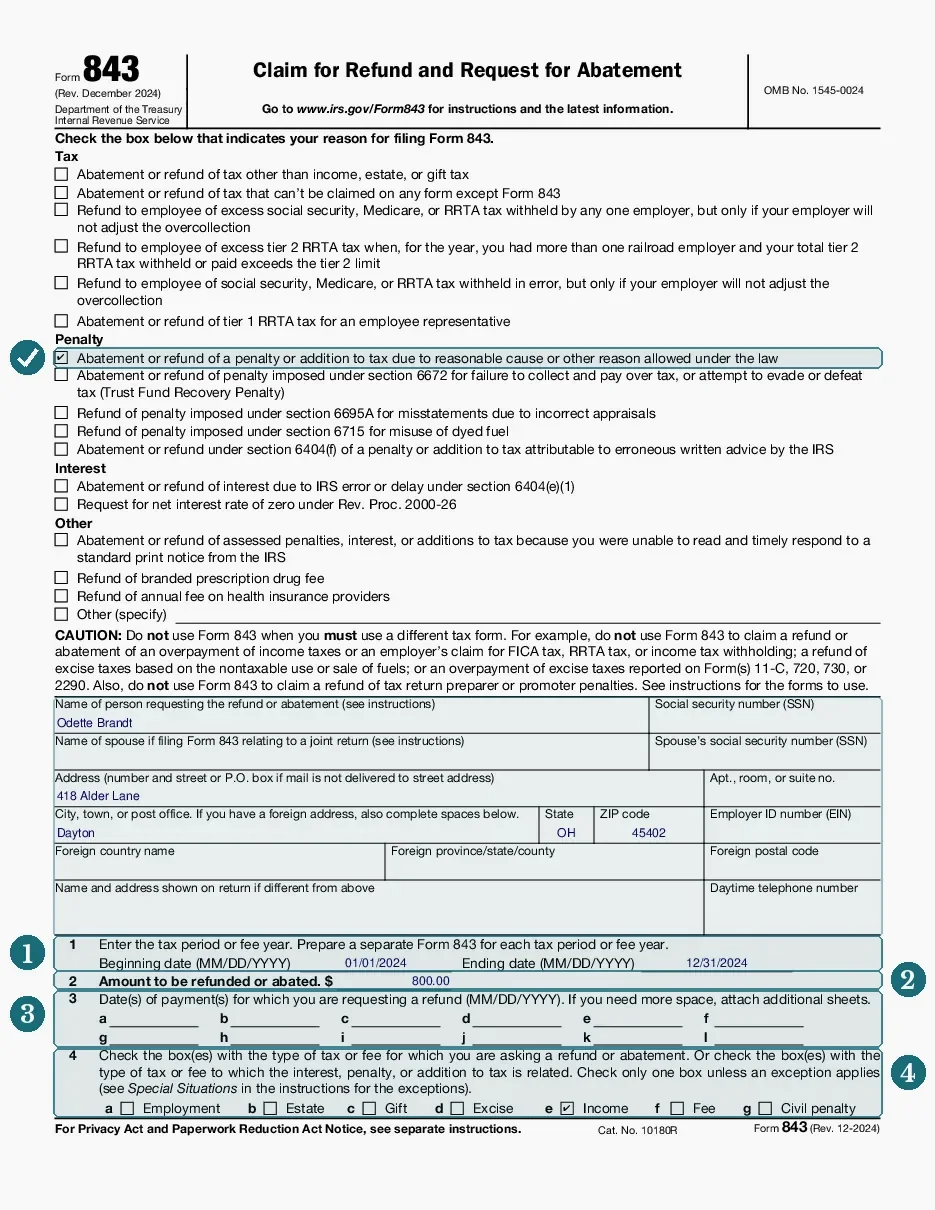
The IRS Form 843 instructions explain each line. Before line 1, check one box at the top. For a penalty, pick the box that ends “reason allowed under the law.” Then write your name, Social Security number and address. The pages shown here are filled in for a made-up person, and each number on them is a line in this list.
- 1The tax period, as a start and end date. For 2024, write 01/01/2024 and 12/31/2024. One form covers one period.
- 2The dollar amount you want taken off. Copy the penalty amount from the notice.
- 3Only if you already paid the penalty and want it back. List the date of each payment.
- 4The kind of tax the penalty is tied to. For a personal return, check e, Income.
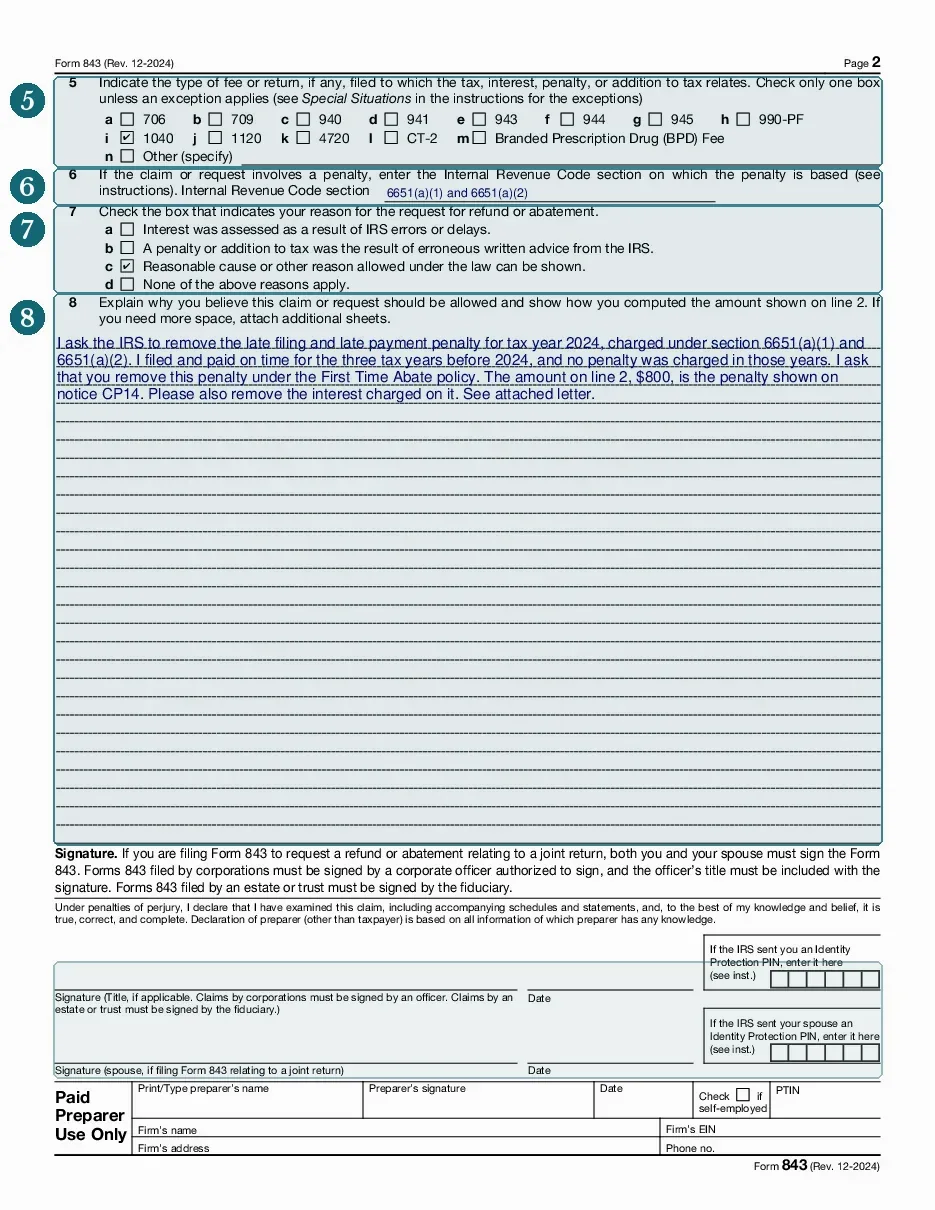
- 5The return. For a Form 1040, check i.
- 6The code section printed on the notice. Late filing is 6651(a)(1). Late payment is 6651(a)(2).
- 7Your reason. Box c covers both first-time removal and a good reason, such as illness.
- 8Your explanation in your own words, with dates. Attach a letter and copies of proof if you need more room.
Sign and date page 2. If the penalty is on a joint return, you and your spouse both sign.
Deadlines and rates
- 3 or 2 years
- to claim back a paid penalty: 3 years from filing, or 2 from paying, whichever is later
- 5% a month
- late filing penalty on the unpaid tax, capped at 25%
- 0.5% a month
- late payment penalty on the unpaid tax, also capped at 25%
- Daily
- interest compounds on the unpaid tax and penalties until paid
Already paid the penalty and want it back? The Form 843 instructions say you generally must claim within 3 years from the date you filed the return, or 2 years from the date you paid, whichever is later. A return filed on August 14, 2025 and paid that day gives you until August 14, 2028. A later payment can give a later date, so check both before you fill in line 3.
A numeric example
A 2024 return filed on August 14, 2025 was four months late, with $4,000 paid that day. The CP14 notice showed a $720 late filing penalty and an $80 late payment penalty. The 2021, 2022 and 2023 returns were filed and paid on time. The table shows each line of this example, as the filler on this page writes them.
| Line | Entry |
|---|---|
| Top box | Abatement or refund of a penalty due to reasonable cause or other reason allowed under the law |
| 1 | 01/01/2024 to 12/31/2024 |
| 2 | $800 |
| 3 | Blank (the penalty has not been paid) |
| 4 | e, Income |
| 5 | i, 1040 |
| 6 | 6651(a)(1) and 6651(a)(2) |
| 7 | c, reasonable cause or other reason allowed under the law |
| 8 | “I filed and paid on time for 2021 to 2023. Please remove this penalty under First Time Abate. See attached letter.” |
The request is short because first-time removal does not need proof. The IRS checks its own records for the 3 earlier years. A reasonable cause request is longer, because the letter has to show what happened and when.
Review the request first
Call a licensed tax pro if this is your first penalty in years. The IRS penalty relief page says some requests are approved over the phone.
Our tax pro can often ask the IRS by phone. Form 843 is the written route: use it when the IRS phone request was refused, or when your reason needs papers. A hospital stay, a death in the family or a fire are examples. A letter with dates and copies makes that case better than a phone call can.
New for 2025 returns: the IRS is moving First Time Abate to an automatic version called Automatic Exemption from Penalty, starting with 2025 returns. Its administrative relief page says this. If a penalty notice still arrives and you had 3 clean years, you can still ask.
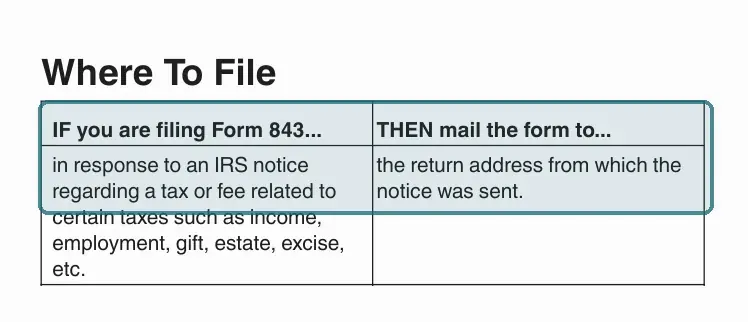
Where to mail it

The IRS mailing table for Form 843 has one rule that covers almost everyone. If the form answers a notice, mail it to the address on that notice.
| Your situation | Mail it to |
|---|---|
| You got a notice about the penalty | The return address on the notice |
| No notice, a penalty or any other reason | The service center where you would file this year’s return |
| Estate or gift tax refund (Form 706 or 709) | IRS, Attn: E&G, Stop 824G, 7940 Kentucky Drive, Florence, KY 41042-2915 |
Send it by certified mail and keep the receipt. Keep a copy of every page you send, too.
How long the IRS takes
The IRS does not publish a set time for Form 843. Its processing status page lists other paper forms it is still working through, which shows how slow its mail can be.
A phone request is the fast way, because the IRS can approve some requests during the call. Interest on unpaid tax keeps adding up daily while you wait, so pay the tax itself if you can.
Other uses of Form 843
The same form covers a short list of other requests, all set out in the IRS instructions.
- Getting back certain taxes, interest, fees and additions to tax, other than income, estate and gift tax. See the purpose of the form.
- Getting back Social Security, Medicare or railroad (RRTA) tax withheld above the limit, when your employer will not fix it. The rules are in the special situations section.
- Interest charged because the IRS made an error or was slow, under section 6404(e). The instructions list what to include.
Two common cases use a different form. An income tax refund needs an amended return, Form 1040-X. An employer fixing payroll tax uses Form 941-X. Mostly to ask the IRS to take off a penalty, interest or a fee. People also use it to get back Social Security tax an employer took by mistake and will not fix. It is not for income tax refunds. The IRS posts no fixed time for it, and its paper mail runs slow. Some phone requests are approved during the call itself, though the IRS warns of long hold times. No. You mail the completed paper form. A tax professional can ask for penalty relief for you by phone instead, which is often faster than the mail. Check the reasonable cause box at the top. Fill lines 1, 2, 4, 5 and 6. Check box c on line 7. On line 8, say you were on time the three years before. The Form 843 filler does every line for you. To the return address on the notice that shows the penalty. With no notice, mail it to the service center where you would file this year’s return. Yes. The instructions ask for one form for each tax period. Two late years means two forms, each with its own letter. You are holding a notice with a penalty you want removed. A licensed tax professional can make the request for you and check whether first-time removal fits. Call 24/7. A licensed tax professional reviews your situation for free.Frequently asked questions
What is Form 843 used for?
How long does the IRS take to process Form 843?
Can I file Form 843 electronically?
How do I fill out Form 843 for first-time abatement?
Where do I mail Form 843?
Do I need a separate Form 843 for each year?
Other help on this site
 Late filing penalty5% of the unpaid tax each month, up to 25%.
 Late payment penalty0.5% of the unpaid tax each month, up to 25%.
 Estimated tax penaltyAdds up for each quarter you paid too little.
 S corp late filing$255 per shareholder each month, up to 12 months.
 Form 941 late deposits2% to 15% of the deposit, by how late it was.
 Trust fund recovery penaltyA Letter 1153 gives you 60 days to appeal.
Getting it removed
Mail it yourself, or have a pro ask
Or have a pro call you back about your penalty